


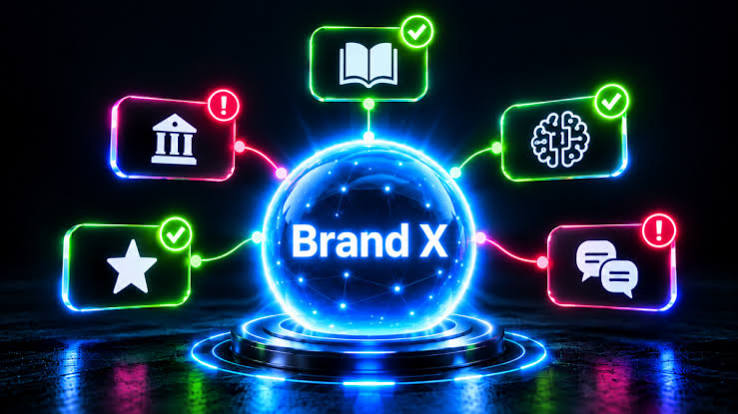
Understanding how entity confusion can completely destroy your brand ai visibility is rapidly becoming a massive strategic challenge for enterprise marketing directors today.
A brand can be correctly categorized by Large Language Models (LLMs) while Google’s Knowledge Graph (KG) simultaneously associates the exact same name with a completely different company. This creates an incredibly unusual situation where information about your brand exists when explicitly named, but the brand drastically fails to surface when the AI model has to retrieve relevant entities independently.
Just as retail directors must optimize their presence within the google universal cart to secure digital checkouts, technical SEO specialists must actively protect their brand ai visibility to survive generative search.
If your marketing department is actively struggling to appear in conversational AI recommendations, here is a complete, data-backed guide to diagnosing and fixing massive entity-resolution problems.
1. The Recognition-Recommendation Gap
Recent empirical research involving 14,140 controlled API runs across twelve brands and five generative AI platforms revealed a massive flaw in how we measure brand ai visibility.
Researchers discovered an unusual case with TALA, a U.K. activewear brand. TALA was correctly placed within the “athleisure” category by the LLMs. However, Google’s Knowledge Graph explicitly described TALA as a “financial services company.” Consequently, the activewear brand appeared in absolutely none of the athleisure or sportswear recommendation responses tested.
This specifically highlights the dangerous recognition-recommendation gap: the massive difference between an LLM successfully knowing who a brand is and actually recommending it to a human user. When a conflict exists at the foundational entity level, your brand ai visibility plummets to zero.
2. Understanding the Entity-Resolution Problem
This specific case illustrates a basic entity-resolution problem that becomes considerably more important once enterprise teams start accurately measuring brand ai visibility.
A commercial name is not necessarily an entity; it is simply a linguistic label that can refer to one or several distinct entities. A computational system encountering that label desperately needs enough structured information to determine exactly which person, company, product, place, or concept is intended before the surrounding attributes can be attached correctly.
Apple is an obvious textbook example because the exact same text string can refer to a massive technology company, a fruit, or a record label. Commercial brand names create this exact same problem on a smaller scale every single day, heavily disrupting brand ai visibility.
3. When Two Different Companies Share a Name
Entity ambiguity of this specific kind is already a highly familiar issue in traditional SEO. However, it severely complicates brand ai visibility in the generative AI era.
For example, search expert Jason Barnard previously documented a particularly useful example involving the name Danny Goodwin. Google’s automated systems had completely conflated Search Engine Land’s Danny Goodwin with a professional baseball player possessing the exact same name. The search engine began wildly associating articles written by the journalist with the entity of the athlete.
This case perfectly demonstrated how two perfectly real entities can easily become entangled when the machine simply does not have sufficiently clear, corroborated signals to distinguish which specific attributes belong to which exact entity.
4. The Danger of a KG-Hijacked Entity
When evaluating your brand ai visibility, you must understand the concept of a KG-hijacked entity. This describes a disastrous case where the Knowledge Graph result officially associated with a brand name points directly toward an entirely unrelated entity.
This creates a massive entity-level conflict that directly coincides with weak or completely absent recommendation visibility for your intended brand. Any organization actively sharing its name with another identifiable entity has some degree of algorithmic ambiguity, but that condition alone does not automatically constitute a KG hijack.
Systems intelligently resolve ambiguous names constantly by deeply using context, digital attributes, structured relationships, and corroborating information to determine which specific entity is intended. What makes a KG-hijacked entity vastly different is that the algorithmic anchor is structurally given to the wrong company, blinding your brand ai visibility.
5. Recognition, Categorization, and Recommendation
To accurately audit your brand ai visibility, you must understand that recognition, categorization, and recommendation are three entirely different algorithmic tests.
Asking an LLM what specific category your brand belongs to already supplies the brand name and narrows the computational task considerably. The system simply has to resolve the intended entity and determine which category is actively associated with it.
However, a recommendation prompt mathematically works in the exact opposite direction. When a shopper asks for recommended athleisure brands, the brand name is completely absent from the initial prompt. The system has to begin strictly with the category, intelligently identify entities sufficiently associated with it, manually assemble possible candidates, and determine which belong in the final answer.
If your entity resolution is deeply fractured, your brand ai visibility will utterly fail the recommendation test, even if the AI knows who you are when directly prompted.
6. Why Zero Recommendations Signal Different Problems
One massive reason the TALA case study is so useful is that measuring recommendation visibility tells us incredibly little about the underlying technical problem when it is measured alone. Treating all digital absences as a generic brand ai visibility problem makes it very easy to prescribe the exact wrong SEO work.
For example, New Balance had the highest Knowledge Graph result score in the study sample and a perfect recognition score, yet it received zero “athleisure” recommendations. Why? Because its Knowledge Graph specifically identified it as a footwear company, not athleisure apparel. The entity was perfectly clear, but its strict association with the requested category was the primary constraint.
Conversely, another brand named LNDR produced zero recommendations alongside extremely weak entity signals across the board. TALA sat somewhere structurally different: the models categorized the apparel entity correctly when pushed, but the Knowledge Graph description belonged to another company. These are three completely different brand ai visibility problems requiring three completely different technical solutions.
7. How to Diagnose an Entity-Resolution Problem
A highly useful brand ai visibility diagnosis needs to methodically separate these technical stages rather than beginning and ending with a generic share-of-voice report.
First, strictly remove the context. Start with deliberately context-poor recognition prompts such as “What is [Brand]?” or “Tell me about [Brand].” Pay close attention to answers that wildly mix attributes belonging to completely separate entities.
Second, test your categorization separately. Once the intended entity is established, explicitly ask which category the system associates with it. A brand that is inconsistently recognized but consistently categorized once disambiguated is exhibiting a completely different failure pattern from a brand that is repeatedly placed in the wrong category.
Third, aggressively inspect the Knowledge Graph. The official description associated with the returned entity deserves incredibly particular attention. A description belonging unmistakably to another organization is a massive diagnostic signal of a hijacked entity ruining your brand ai visibility.
8. Fixing the Entity Before Fixing the Recommendation
Before investing heavily in more content, expensive digital PR, schema markup, or third-party mentions, you must ask a far more fundamental question: When AI systems encounter your brand name, which exact entity do they actually identify?
A confirmed entity collision completely changes your technical optimization priority because the immediate task becomes intense disambiguation. You must establish that two organizations sharing a name are definitively distinct entities.
This directly involves strengthening your foundational entity home, successfully reconciling organizational information across authoritative profiles, clarifying relationships with specific founders and products, and actively submitting structural corrections where Google’s Knowledge Graph contains a wildly conflated representation.
The primary objective is to strategically provide enough perfectly consistent evidence for the machine to distinguish between two entities, thereby restoring your brand ai visibility across all major generative models.
For foundational technical guidelines regarding knowledge graphs, consult the official documentation surrounding Knowledge Graphs, and review modern structured data research directly on Google Search Central.
Frequently Asked Questions
What is brand ai visibility?
Brand ai visibility refers to how consistently and accurately large language models (LLMs) and generative search engines can recognize your specific company, categorize your products correctly, and recommend your business to users natively without being explicitly prompted.
How does entity confusion hurt brand ai visibility?
Entity confusion occurs when an AI algorithm conflates your company with another business or concept sharing the exact same name. This heavily damages your brand ai visibility because the AI may attribute your content to the wrong organization or recommend the other company instead of yours.
How can I fix a Knowledge Graph hijack?
To fix a hijacked Knowledge Graph and restore your brand ai visibility, you must heavily establish your “entity home” by ensuring your About page, Wikidata entries, and structured schema markup perfectly align and explicitly differentiate your specific company from the conflicting brand.

