


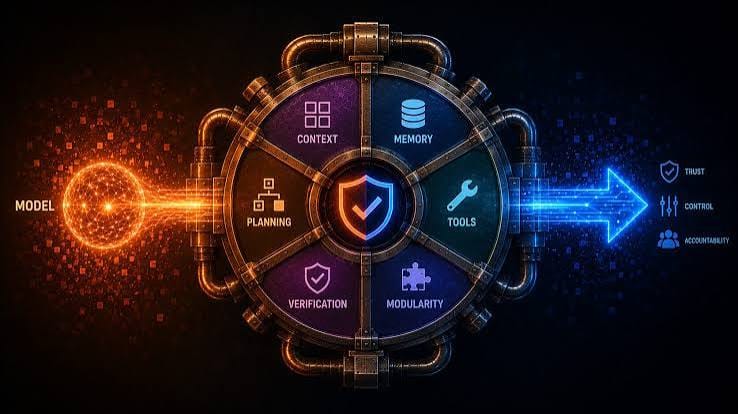
The most exciting area of development in enterprise artificial intelligence right now isn’t foundation models, nor is it even autonomous agents: it is the custom AI harness. Companies including Salesforce, DeepSeek, Xiaomi, and Google are increasingly offering specialized harnesses designed to dramatically enhance underlying AI models. These systems improve reliability on specific, repeatable, yet open-ended tasks by providing the AI model with a dedicated layer of software, tools, context, and operating instructions.
But should your company build its own dedicated custom AI harness to accomplish specific business tasks? And can your internal harness be productized? Digital publishing and media startup Inkitt recently did exactly that. Today, they launched Inkitt Movie Creator, a public beta designed to turn text-based scripts into AI-generated films in minutes. Just as developers must rigorously secure their internal codebases coding agents monorepo security secrets, enterprise leaders must architect proper frameworks for their AI workflows. Here are 5 amazing secrets from Inkitt’s journey to build a custom AI harness.
Table of Contents
- How Cinematica Proves the Value of a Custom AI Harness
- Lesson 1: Base Your Custom AI Harness on Real Internal Workflows
- Lesson 2 & 3: Encoding Human Expertise into the System
- Lesson 4 & 5: Model Agnosticism and External Knowledge
- Pricing, Microdramas, and Benchmarking the Custom AI Harness
- Frequently Asked Questions
1. How Cinematica Proves the Value of a Custom AI Harness
Inkitt Movie Creator is powered entirely by Cinematica, an internal custom AI harness created by Inkitt’s in-house AI video production experts. This system orchestrates different image, video, and language models while actively encoding real-world filmmaking techniques. Instead of building another foundation video model to compete directly with ByteDance’s Seedance or MiniMax, Inkitt founder and CEO Ali Albazaz is betting the larger opportunity lies in making existing models easier to control.
“There’s a lot of choice there, and we don’t want to compete there at all,” Albazaz said. “What makes Cinematica special is the harness.”
Research proves that harness engineering matters heavily. Xiaomi’s HarnessX recently improved performance across 14 of 15 model-benchmark combinations, producing an average absolute gain of 14.5% without swapping in a stronger foundation model. Cinematica represents a highly tangible attempt to apply this principle to creative production. Rather than train a better movie model, Inkitt built a better system for directing the movie models that already exist. To understand the broader technical architecture of software wrappers, you can explore programmatic interfaces on Wikipedia.
2. Lesson 1: Base Your Custom AI Harness on Real Internal Workflows
Cinematica absolutely did not begin as an abstract platform project in search of a commercial use case. According to Albazaz, it originated in early 2026 because Inkitt possessed a growing catalog of e-books that it desperately wanted to turn into films for Ironblood, its AI video streaming service.
Conventional production economics made adapting these stories at massive volume completely impractical. Inkitt started with a recurring, highly expensive business problem: how do we use rapidly improving video models to produce many longer-form movies without rebuilding our production workflow every single month? The custom AI harness emerged as the definitive answer.
Albazaz used a brilliant automotive analogy to describe the transition from internal infrastructure to a public product. “We created this Formula One car, if you will, to help us create these movies internally, and now we’re turning it into a Honda CR-V so that externals can start using it,” he explained. Enterprises should strictly follow this template: solve a real workflow for your own employees first, and only then consider whether the custom AI harness should become a commercial product.
3. Lesson 2 & 3: Encoding Human Expertise into the System
The human beings doing the manual work are absolutely central to Inkitt’s approach. Albazaz noted that roughly 15 video producers are actively working across Ironblood and Cinematica. These employees are not simply end-users; they effectively function as an ongoing R&D organization for the custom AI harness.
During daily meetings, the production team discusses new techniques and immediately productizes them into Cinematica. If an AI-generated character’s skin looks unpleasantly waxy, or if a model swaps character faces during a moving shot, the harness encodes the exact techniques producers have found useful for correcting it. Instead of asking an AI system to blindly eliminate a domain expert’s job, Inkitt puts those experts inside the optimization loop.
By turning recurring failures into reusable system knowledge, Inkitt transforms basic troubleshooting into permanent institutional memory. This means the most valuable asset for an enterprise is not just proprietary data, but the tacit operational knowledge actively held by employees who understand the workflow better than the AI does.
4. Lesson 4 & 5: Model Agnosticism and External Knowledge
A powerful custom AI harness does not require inventing every single technique internally. Inkitt’s producers actively monitor techniques shared publicly by the wider AI-video community, particularly on social media, and combine that generally available knowledge with internal workflow data that competitors do not possess.
More importantly, Inkitt specifically architected Cinematica so that the harness remains completely separate from the underlying models. Creators are never locked into one specific video generator. Cinematica can seamlessly select among different systems based on quality and cost—utilizing ByteDance’s Seedance 2.5 for expensive, high-quality generation, or MiniMax H3 when users want to keep production costs lower.
“We’re not bound to one model,” Albazaz confirmed. “We will give you the best tools.” For an enterprise, this model-agnostic approach perfectly prevents the business process from becoming tightly coupled to whichever AI provider happens to be strongest today. The accumulated workflow rules stay securely inside your custom AI harness, regardless of which foundation model you plug in.
5. Pricing, Microdramas, and Benchmarking the Custom AI Harness
Inkitt Movie Creator is officially available today, producing polished content for an estimated $75 to $500 per final minute. Based on their credit bundles, raw generation costs roughly $20.60 to $21.20 per minute. While calling lower-cost APIs like Google Veo 3.1 Lite or MiniMax H3 directly is technically cheaper, Inkitt’s premium covers the massive workflow intelligence, continuity management, and asset orchestration provided by their custom AI harness.
Backed by a massive $117 million in funding from investors (read more about tech capital on TechCrunch), Inkitt sees immediate enterprise applications in branded “microdramas.” Brands like Crocs and JCPenney are already experimenting with these short-form narrative advertisements. At roughly $4,500 to $30,000 for 60 minutes of AI output, Cinematica makes serialized branded entertainment incredibly cost-effective to test before committing to conventional production budgets.
The only remaining question is exact benchmarking. Inkitt has not yet released hard data comparing Cinematica’s character consistency or production-time reductions against raw models. However, the overarching lesson remains undeniably clear: the next stage of enterprise AI competition depends heavily on who is best at wrapping a custom AI harness around the hard-won expertise of their own people.
Frequently Asked Questions
What is a custom AI harness?
A custom AI harness is a dedicated software layer built around an artificial intelligence foundation model. It provides specific operating instructions, tools, context, and automated workflows to make the underlying AI model perform highly specialized, repeatable enterprise tasks more reliably.
How does Inkitt’s Cinematica work?
Cinematica is Inkitt’s proprietary AI video harness. Instead of training its own video models, Cinematica orchestrates existing models (like Seedance and MiniMax) and encodes real-world filmmaking techniques to maintain character consistency, camera angles, and shot continuity automatically.
Should my business build an AI harness?
Yes, if your business has a highly repetitive, expensive internal workflow. By building a harness, you can encode the troubleshooting expertise of your top human employees into a reusable software layer, ensuring your business process remains efficient regardless of which AI foundation model you use.

